
Thursday, July 29, 2010
Old but really cool
This is a clip from the Architecture and Design Curator at MOMA. She is discussing a exhibition that she was opening in 2008. I thought that her combination of scientists and designers - it is a cool concept for a show. Weird but cool....
Thanks TED.COM
Electronic Recyclers Video
Every morning I scan through a few websites and blogs looking to stay updated on everything in the world and in design. This morning I found a video that a site Core77 had found on Youtube
( this link brings you to more videos link the one shown here)
This short 6 min clip goes over how electronic waste is recycled and let me tell you if you design products or plan to design products it is shocking to hear all of the statistics. I watched it twice just to make sure that I heard correctly. :)
Core77 said in their posting "I hope they start showing videos like this in design school (if they haven't already) to inspire the next generation to design things so that they not only fit together well, but come apart in a manner that facilitates their materials being harvested. In the meantime, there's hammers." (Core77 Posting)
Sunday, July 25, 2010
Homeopathy & Nutritionists vs Real Science
I found this video on Unreasonable Faith and was laughing at what is so obvious and yet, many fail to place their faith on science rather than witch doctors. Oh well, watch and enjoy.
Sunday, May 2, 2010
Creationism Propaganda Aimed at Kids
I recently found this video through one of the sites I frequent, Unreasonable Faith. This video was posted to show creationism propaganda for Children. Yes, it made me sick.
Thursday, March 11, 2010
The Kentucky Ag Center Might Not Happen
Sadly news has come that Mr. Anderson of the Belcan Corporation has passed away. The project that they started, The Kentucky Agricultural Center, had not yet begun and construction may be postponed indefinitely.
Monday, November 30, 2009
The Kentucky Agricultural Heritage Center
Over the past years Kentucky has silently been working through on being on the the most environmentally friendly states out there. Their Agricultural Center should prove to be no different.Normally in a small farm house, they started to look for something more advanced.Recently the state of Kentucky and the Agricultural Center have been working with a small Cincinnati Corporation Belcan, to make sure that the Ag Center becomes all that it can be. Belcan was chosen by the Governor of KY. The CEO of Belcan being from the south of Kentucky has always given back to his home state. He has fully restored his home town, and with the Ag Center being only a few miles away from it, it was a better suiting than most would think.
 Their mission statements, "to create an environment for learning, reflecting on the past, showcasing the present and fostering the advancement of Kentucky Agriculture.", was kept in mind when sitting down to redesign the overall look to everything. Their want to promote all things Agricultural in Kentucky was a big key they educate people of all types and ages, they want to blend the modern techniques with the past.
Belcan Architects sat down and began to think and to work. The idea to make sure that it was as environmentally friendly as possible was always the main goal. What it started to become was something that no one had any idea of.
Even though this grass roots project is still near the beginning of construction it is still a small ways away the deign and main goals have already been met and and ready to be implemented. There will be wind turbines, to gather energy,solar panels, a gray water system other than your typical one, there is also have geothermal capabilities. The Ag Center will be a fully sustainable building creating and renewing all of its own energy. One of this scale would be one of the first in the United States once it is completed. This 300,000 square foot facility will be a fully sustainable one. Showing off all of Kentucky Agricultural history inside and showing off the plant life all around it on the grounds. The building windows were even placed specifically due to when and what time the sun would hit certain sides. This way having control of where the heat enter the building and where it doesn't.

 These photos compliments of Belcan and the Beaumont Inn.
“This could be one of the first facilities in the U.S. that is focused on sustainability from initial design,” tells Isaac Gilliam, lead Architect for Belcan.
Once built anyone should take the trip down to Kentucky to see the amazing building that has been design by Isaac Gilliam and Belcan.
Kentucky Ag Center
Belcan
Beaumont Inn
Thursday, November 19, 2009
Sharkskin and the Navy
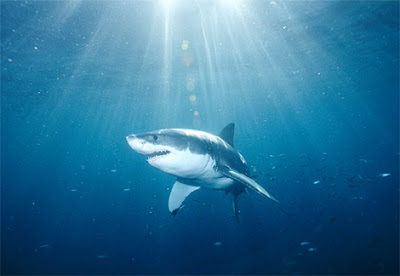
Biofouling, an industry name for accumulation of microorganisms, plants, and/or animals on wetted structures, adds to fuel costs for the military and shipping industry as well as increasing drag up to 15 percent. According to Live Science, the Navy spends about $50 million just on bio-fouling and paints laced with deadly biocides curb problem, but these substances are toxic to marine life. Although sharks are also attacked by biofouling, they stay clean. How is this possible?
A shark's scales are made of a hard material called dentin and act as tiny teeth. These special scales are also pointed backward, so they feel smooth when stroked from head to tail but rough in the other direction. The scales also act as armor for a shark, creating tiny vortices that reduce drag, and allow sharks to swim silently.
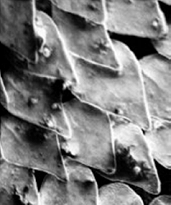
A synthetic shark skin of elastic silicone that makes it harder for barnacles to gain a foothold has been created in Bremen, Germany by Ralph Liedert of the University of Applied Sciences. "While simpler in design than shark scales, the ship skin reduced biofouling by 67 percent in tests," states Live Science. "With the fake skin applied, a ship moving at 4 to 5 knots becomes self-cleaning, removing most organisms."
The University of Florida, in separate work funded partially by the U.S. Navy, has developed a similar coating, made of tiny diamond-shaped scales that flex in and out to impede the growth of organisms. The spore settlement has been reduced by 85 percent. While the high-tech skins could reduce costs for the shipping industry, they could prove a strategic advantage for the military.
Cactus Building
 My mother used to collect anything cactus. Salt and pepper shakers, plates, and hand towels with cactus appliques adorned the house. That's nothing compared to the Bangkok-based Aesthetics Architects Go Group who have designed the minister of Municipal Affairs & Agriculture's (MMAA) new office building in Doha Qatar, also known as the cactus projects.
According to DesignBoom, "the building's design draws its inspiration from the ability of cacti thriving in the desert." The building features sunshade panels that open and close according to the sun's intensity. A cactus, similar to the building, performs transpiration at night rather than the day because, as described by inhabitat, it helps retain water. The cactus building is energy efficient and has a botanic dome at the base of the tower that will eventually contain a botanical garden, adding to it's "green rating".
The Aesthetics Architects Go Group is recognized for their innovative approach to sustainable architecture. They kept in mind that Qatar, as stated on Qatar Embassy, receives an average of 3.2 inches of rainfall a year and is mostly barren, sand-covered land.
Now, if only I could get rid of all the cactus hand me downs from my mother, who, by the way, has moved on to roosters.
Saturday, November 14, 2009
Body Armor
Have you ever heard of the fish Polypterus Senegalus? Not many have, but this African fish has given scientist a new topic of discussion and of research, body armor. The fish has many layers of scales on its body, the way that the scales are composed and laid out are what caught the attention of a few scientists. Each scale of the fish is part of four layers, each of which is composed of bone and dentin. They way that these layers are shaped and spacing between each layer creates an extremely strong it can be compared to armor.
Scientists have used the research found from this fish to adapt and improve soldiers body armor for the military. The research is still new and is being worked out now. Here is just yet another example of how Mother Nature’s design can help us at times more than we expect.
 Nature
Thomas Net
 Nature
Thomas Net
Mussle Glue
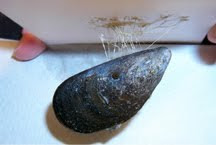
Ever wonder how marine muscles attach themselves to rocks and other things while at sea? Muscles produce a natural glue that enables them to stick or attach to things such as rocks, glass, woods and many other materials as well.
Researchers at the North Carolina Sate University Have taken on the task of trying to find a way to take the attributes of the glue and bring it in to the medical field. They have found that the adhesives are in fact proteins; they are biodegradable and non-toxic in their components.
In the medical fields there are needs to aid in forming tissues back together, as of now there are the usage of sutures as well as synthetic adhesives. Both include a few complications of their own, for both the patients as well as the doctors.
Using ink jet technology scientist have found that when used in a solution the glue that is created by muscles can take the place of these medical tools. This technology can aid patients heal faster when dealing with surgeries. It joins tissues faster, when the adhesives wears off the tissues are fully connected and healed.
 Science Daily
Thomas Net
 Science Daily
Thomas Net
Nano Air Vehicle
Everyone loves finding maple seeds in the spring and trying to get them to fly like helicopter wings. The maple tree is part of the Acer family; it is Latin for “Sharp”. These seeds that we grew up playing with may have gone as far as a mile before settling down. As the seeds fall from the trees auto-rotation takes place, it allows the seeds to gain a little extra air as it falls.
These small seeds caught the attention of David Lentink, an aerospace engineer; he realized that there was something there with in the design of these seeds. He saw ran a few studies and saw that there are a lot of the same commonalities between a seed and an oil tank. He filled a small tunnel in his labs and filled it with smoke, taping the seed as it fell. He saw that the falling seed creates tornado like effect that happens around the edges of the seed. This is much like a set of helicopter wings this pulls the edge of the seed up increasing an opposition of gravity.
This simple design from nature has inspired scientists to create the Nano Air Vehicle (NAV’s). This device is remote controlled to aid the military in checking for missions that might be in difficult weather. What the purpose if this new technology is so that when flying over an area military personal can drop the NAV’s out of a plane, they can control where they are headed by using the remote control as well as the camera that is placed in the wing of the unit, it send back information to the personnel in a hand held unit. This small piece can travel at 10 meters per second and can go as far as a 1,000 meters. After sending all of the information needed the remote can have the NAV come back to the personnel to be adjusted for it next mission.
This new technology can aid the military in mane new ways. New functions for it are being developed. All of this information can from an idea of a simple seedling falling from a tree, a another well thought out design from Mother Nature.
 Lockheed Martin
Tree Hugger
 Lockheed Martin
Tree Hugger
Gecko Tape
Gecko’s, not just another one of Geico’s ad campaigns, these creatures are small lizards that seem to like warm climates throughout the world. There are about 2,000 types of Gecko’s. All of them have the same type of special feature that has caught the attention of scientist and designers.
 Geckos feet are extremely well designed by nature. Their toes allow them to attach to many types of surfaces. This is possible because there are very small hairs on the bottom of the toes that are able to grip to surfaces and able to hold the gecko’s as they move. They adhere to surfaces by sliding on to the surface it self, this is how it attaches. The hairs also clean themselves in efforts to keep the Geckos safe from bacteria. As they walk there is a “peeling action” that takes place. As the Gecko walks it changes the way that the bristles attach themselves. As they lift their feet they do so with the tips of their toes facing the inside.
This complex natural design has inspired people to look at adhesive tape differently, average tape is applied by sticking to surfaces and holding them there. Most tapes on the market are not known to be very strong where as the Geckos feet can hold a good amount of weight.
 A Gecko Tape has started to be developed and is accomplished by using plastic micro fibers. All of these fibers are working as a whole, and when slid on to a material it can carry a heavier load for longer. The best part of this is that there is no need to worry about the entire residue that is left by the average adhesive tape.
This is the “first hard Polymer micro fiber which can attach with out requiring high pressure” There are hopes to develop this concept more and be able to bring it in to the medical fields as well as sporting goods, climbing usage etc.
Gecko Tape
Wise Geek
Smart Gecko Tape
Friday, November 13, 2009
Velcro
 Once upon a time in the far away land of Switzerland and an inventor, George de Mestral, decided that it was a good time to take his dog out for a nice stroll though the hills. During the walk the dog came in contact with a few bushes and ended up coming home with a few new friends
Noticing this the inventor decided to take the dog, still covered, to his in home lab where he examined the situation. Using his microscope he removed a burr and closely examined it. Burrs are seed carriers, this is why they have developed these hook like structures that attach easily to fabric as well to fur.
Mestral said thinking, "I will design a unique, two-sided fastener, one side with stiff hooks like the burrs and the other side with soft loops like the fabric of my pants. I will call my invention 'Velcro' a combination of the word velor and crochet. It will rival the zipper in its ability to fasten." After many tests, and trials there was finally an answer. When Nylon is used, Hooks can be created to mimic the structure of those on the burrs.
 There were many issues when getting started. No one wanted to take on the project and make it happen. The design was finally completed in 1955, Mestral created Velcro Industries. Today it is a multi-million dollar industry, as well as a household name.
Idea Finder
Inventors. About.
Toad Tongue Are the New Muscle Tendon
 Suddenly there is snap out of nowhere comes a pink flash, and the fly is gone. The Toad swallows it and then disappears in to the pond. Toads (amphibians in the order Anura. Family) are known for their well designed tongue that has started to show us that it can do more than just catch flies on a sunny day. The muscle itself can create a force that is 700x more powerful than the toads’ total weight.
Considering the mechanics of this powerful muscle researchers have found that it can be taken in to the design of new and better tendons for humans. Arizona's State Universities Human Machine Integration Laboratory are creating SPARKy (Spring Ankle with Regenerative Kinetics). When made this will store and give out energy while the cycle of the ankle in is full work. When created the device can be used for neuromuscular diseases such as Parkinson’s.
More and more information is coming out about this fascinating new discovery. This could be used to aid the design of electric motors.
 NAU
Medical News Today
Thursday, November 12, 2009
Morphotex
Among the most vibrant insects in the world, the Blue Morpho Butterfly, scientifically known as Morpho peleides, is one of the largest butterflies in the world, with wings spanning from five to eight inches, but despite their stunning color, their wings aren’t a true blue.

How is this possible? According to the Saint Louis Zoo, The Blue Morpho Butterflies have tiny, overlapping scales covering their wings similar to roof shingles. The iridescent blue color comes from the scales on their wing tops, which have tiny ridges that reflect blue light.
These luminous Blue Morpho butterflies were the inspiration for Morphotex fibers. Kathy Witkowsky, author of the article "Replicating Success", stated that in 2000, Nissan incorporated the structural-color fiber Morphotex into the front seats of the Silvia Convertible Varietta.
Nissan, the engineering-design firm Teijin Limited, and Kawashima Textile Manufacturers jointly developed Morphotex. The material is made to shimmer through the arrangement in polyester and nylon as well as varying thickness of the fibers, even though the fibers themselves have no color. According to Teijin Fibers Limited, because there is no dye used, less energy is used and the material is recyclable without the by-product of contaminated liquid waste.
As stated in Teijinfiber.com, “[Morphotex's] colors change according to the strength and angle of light which creates an elegant texture and gloss with transparency as if they were taken out from the rainbow.” Morphotex can be used for textiles, interior materials, and the fabric can show blue, red, purple, and green depending on how the light shines on it.
Sunday, November 1, 2009
Bionic Penguins
This clip shows awesome bionic penguins that are designed as autonomous underwater vehicles that independently orient themselves and navigate through the water basin.
The Future Makers 1. Biomimicry
Here is a link from Change 2 talking about Initially what biomimicry is and some of the designs that have come form this thought process.
The Future Makers 1. Biomimicry
Lunocet -- Becoming Fish
Here's a clip on Lunocet. Created by Ted Ciamillo, the monofin is putting beyond-Olympian speeds within reach of just about anyone.
Janine Benyus: Biomimicry in action
 These are two videos from TED.com. In these short clips Benyus talks about how we all need to look at nature initially before going to solve a problem.
TED Link 1
TED Link 2
Sunday, October 25, 2009
What is Biomimicry?
With a look of concentration usually only seen on college students working on their thesis, my younger cousin would try to fit the yellow wooden cube into the round hole of the shape box. Designing without using nature as inspiration is similar to trying to fit the wrong shape into the circular hole.
This is where Biomimicry comes in. Essentially, Biomimicry is the emulation of nature to solve human problems. Janine Benyus, author of Biomimicry: Innovation Inspired by Nature, states that “In a society accustomed to dominating or "improving" nature, this respectful imitation is a radically new approach, a revolution really.” And the revolution has already started to sprout in various parts of the world.
In Harare, Zimbabwe, the country's largest office and shopping complex, designed by Mick Pearce and engineers at Arup Associates, was designed to mimic the way that termites in Africa construct their mounds to maintain a constant temperature. The building, called the Eastgate Centre, uses air circulation similar to the termites. The critters constantly open and close vents throughout the mound to manage air. This method uses less than 10% of the energy used in similar sized buildings but most importantly, according to architectsforpeace.org, the owner saved $3.5 million of energy costs in the fist five years.
In 2004, as stated by www.worldchanging.com, Duke University in conjunction with researchers at West Chester and the U.S. Naval Academy found that “the bumpy "tubercles" along the front edge of humpback whale pectoral fins cause them to be more efficient and effective than anything in use on today's airplanes.” Tunnel tests concluded that flippers with bumps performed about eight percent better than smooth flippers, withstood stall at a forty percent steeper wind angle, and thirty-two percent lower drag. The bumps can be implemented on airplanes, not only using less fuel but would make the the plane more maneuverable.
So where do you go from here? Start looking around at what nature who, after 3.8 billion years of research and development, has managed to develop solutions to human issues in design and please, stop trying to push the wooden cylinder into the square-shaped hole.
Subscribe to:
Posts (Atom)


